SSH: Sustainable Social Housing
- Mirko Vlahovic
- 5 jun 2017
- 2 Min. de lectura

Inequality reduction by promoting social inclusion and sustainable cities are two of the “17 Sustainable Development Goals To Transform Our World” that several countries adopted in September 25th 2015, as part of the United Nations 2030 Sustainable Development Agenda. Providing access to social housing is imperative to tackle those goals. Make it happen is not simple, since most countries face different barriers, being the lack of funds the main reason. Admitting the economic limitation, will it be possible to build sustainable social housing?
In Chile, and innovative initiative is trying to make it happen. It is called Construye Solar, “a challenge that invites universities in Chile and worldwide to develop prototypes of sustainable social housing, in order to change the perception of social housing in the country. The prototypes are built to real scale and then showed in a large public exposition. Prototypes are evaluated based on their energy efficiency, comfort and sustainability, among other aspects” (Construye Solar 2017). Basically, is a social housing competition.
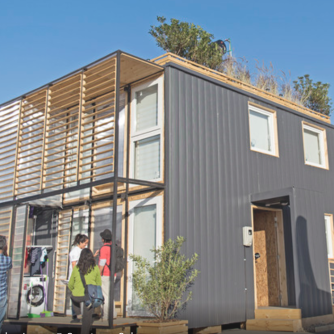
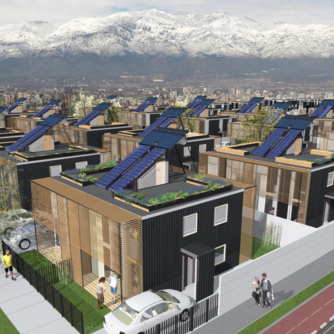
Casa S³, a project with special emphasis on privacy and recreation places was the winner of the second edition of the Chilean contest that finished in May 7th 2017. The main characteristics of the house are:
56 sqm attached house constructed with SIP (Structural Insulated Panels) panels.
Passive design: stairs work like a ventilation chimney.
Two levels and a vegetable garden terrace.
Energy efficiency: 54% in water and 56% in electricity total savings.
Expandable house: an additional room and bathroom can be added if needed.
High-density purposes: the house has a floor occupancy of 34%. The town, a density of 55 dwellings (275 inhabitants) per hectare.


Despite the total cost of the house is not informed, this seems to be an interesting way for addressing social housing in our cities. Initiatives like Construye Solar in Chile should be emulated by other countries, because beyond being a contest, it demonstrates that with the commitment of different actors like government, private sector and universities, sustainable development could be possible.
Comentarios